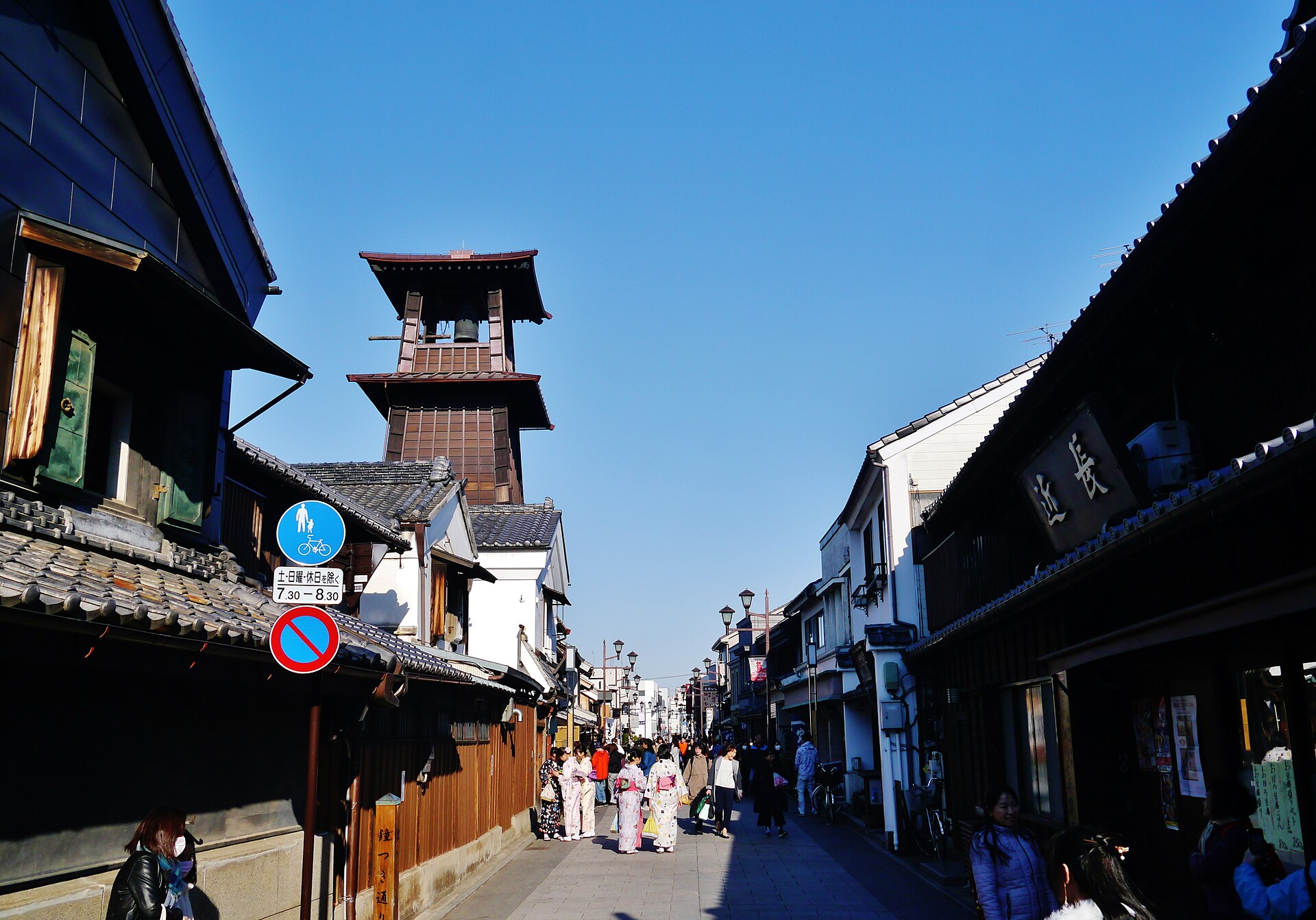
Black clay walls, heavy tiled roofs and a wooden bell tower ringing over the street: Kawagoe is called “Koedo”, Little Edo, and it lives up to the name.
The warehouse district
Kawagoe grew rich as a castle town and as a trading center that supplied Edo (old Tokyo) by river. After a great fire swept the town in 1893, merchants rebuilt their shops in the fireproof kurazukuri style, with thick clay walls and heavy shutters. More than 200 of these buildings remain along Kurazukuri Street (Ichibangai) and nearby lanes, and most are now shops, cafes and restaurants.
Look for the Osawa House, the oldest kurazukuri merchant house on the street, and the Kurazukuri Museum, set in an old tobacco wholesaler’s shop.
Toki no Kane, the Bell of Time
Just off the main street stands Toki no Kane, a three-story wooden bell tower about 16 meters tall. A bell tower has told the town the time here since the early Edo period; the current tower was rebuilt after the 1893 fire. Today the bell rings mechanically four times a day, at 6:00, 12:00, 15:00 and 18:00, and its sound was chosen as one of the “100 Soundscapes of Japan”.
Kashiya Yokocho, Candy Alley
A short walk away, Kashiya Yokocho is a narrow lane of small shops selling old-fashioned Japanese sweets and snacks, a tradition dating back to the Meiji era. Kawagoe is also famous for sweet potatoes: try sweet potato ice cream, chips and imo kenpi as you walk.
Tips
- Weekends are very crowded. Arrive early, or come on a weekday.
- Rent a kimono for the day; several shops near the bell tower offer rentals.
- Walk Taisho Roman Street between Hon-Kawagoe Station and the warehouse district for early-20th-century architecture.
- Add Kitain Temple and the Kawagoe Hikawa Shrine to your day.
Getting there
From Ikebukuro, take the Tobu Tojo Line to Kawagoe or Kawagoeshi Station (about 30 minutes), or the Seibu Shinjuku Line from Seibu-Shinjuku to Hon-Kawagoe. From Kawagoe Station, buses run to the Ichibangai stop near the bell tower.
Sources and further reading
- Japan-guide.com: Kawagoe Warehouse District
- Tobu Railway: Kawagoe sightseeing
- GLTJP: Toki no Kane
- JNTO: Kawagoe itinerary
Featured image: Zairon / Wikimedia Commons (CC BY-SA 4.0). Practical details such as prices, hours and schedules change often. Please check the official sources before you travel.