Most visitors to Japan never set foot on Shikoku, and few who do make it as far as the Iya Valley. That is exactly why it is worth the effort: steep, forested slopes, farmhouses clinging to the hillsides, and bridges made of mountain vines that creak under your feet.
A valley of hideaways
The Iya Valley follows the Iya River through the western part of Tokushima Prefecture. For centuries it was one of the most isolated places in Japan, and local legend says that warriors of the defeated Heike clan fled here after losing the Genpei War in the 12th century. Whether or not the story is true, the valley still feels like a place where people came to disappear.
The valley is usually divided into two parts. Nishi-Iya (West Iya) is easier to reach and has the best-known bridge, hot spring hotels and a few restaurants. Oku-Iya (Inner Iya, also called Higashi-Iya) lies much further up the valley and is very hard to reach without a car.
Iya Kazurabashi: the classic crossing
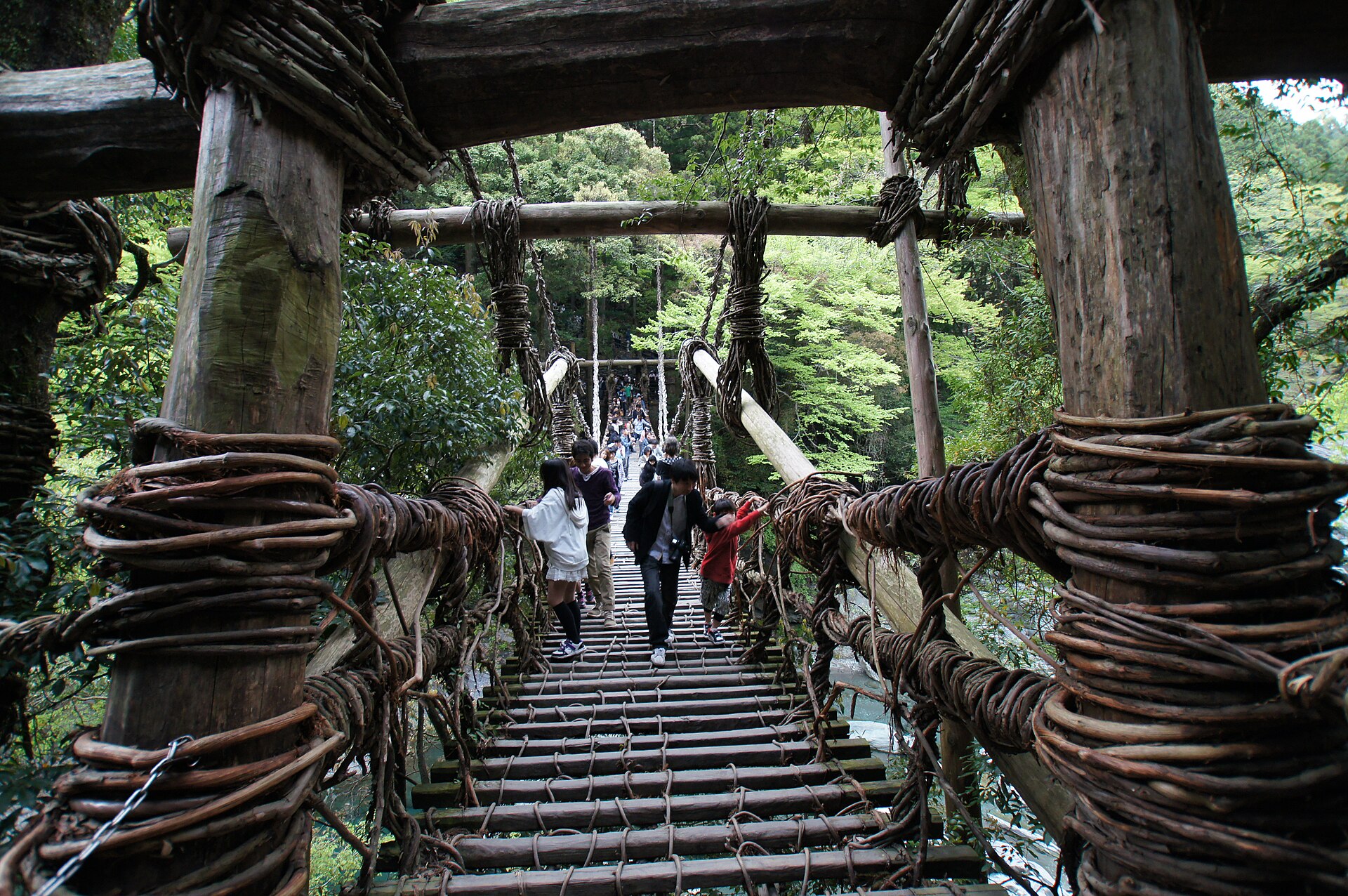
In the past, around 13 vine bridges spanned the river and were a lifeline for villagers moving people and goods across the gorge. Only three remain today. The largest, the Iya Kazurabashi, is about 45 meters long and hangs roughly 15 meters above the water. It is a designated Important Tangible Folk Cultural Property of Japan.
The bridge is woven from hardy kiwi-family vines. For safety it is now reinforced with hidden steel cables, and the vines are replaced every few years, which can close the bridge for some weeks in winter. Walking across is a slightly nerve-racking experience: the gaps between the wooden slats are wide, the whole structure sways, and you can see straight down to the jade-green river.
| Location | Zentoku, Nishi-Iya, Miyoshi City, Tokushima |
|---|---|
| Hours (approx.) | 8:00–17:00 most of the year; longer hours in spring and summer |
| Admission | Around 550 yen for adults |
| Night view | The bridge is lit up in the evening, but you cannot cross it at night |
Oku-Iya Double Vine Bridges
If you have a car, keep driving east for about an hour along narrow mountain roads to reach the Oku-Iya Niju Kazurabashi, a pair of vine bridges known locally as the “husband and wife” bridges. They are a little smaller than the main bridge but far quieter, and they hang over a beautiful stretch of clear river.
Next to the bridges you can also try the yaen, a hand-pulled cable car: you sit in a wooden box and haul yourself across the gorge with a rope. It is harder work than it looks. The Oku-Iya bridges are closed in winter (roughly December to March), and the autumn leaves here usually turn earlier than in the rest of the valley, around late October to early November.
Getting there
- By bus: local buses run from JR Awa-Ikeda Station (about 60–70 minutes) and from JR Oboke Station (about 25–30 minutes) to the Iya Kazurabashi area. Services are infrequent, so check the timetable in advance.
- By car: the main bridge is about 70 minutes from the Ikawa-Ikeda Interchange. A rental car is strongly recommended if you want to see Oku-Iya.
- Combine with: Oboke Gorge rafting and the scarecrow village of Nagoro, both in the same area.
Tips for your visit
- Wear shoes with a good grip and keep phones and cameras on a strap. Things dropped through the bridge are gone for good.
- Come early in the morning to cross the main bridge before the tour buses arrive.
- Stay overnight in the valley. A night in a renovated farmhouse or a hot spring inn is what makes Iya special.
Sources and further reading
- Japan-guide.com: Iya Valley
- Miyoshi City Tourism: Iya-no-Kazurabashi
- JNTO: Kazurabashi Bridge
- Discover Tokushima: Vine Bridges of Iya Valley
Featured image: ume-y / Wikimedia Commons (CC BY 2.0). Practical details such as prices, hours and schedules change often. Please check the official sources before you travel.